Professional Film Processing in Washington, DC
Learn about film processing, film types, and how to safely mail your film to National Photo.
Get StartedWhether you've just picked up your first film camera or you're rediscovering analog photography after years away, getting your film developed can feel intimidating, especially if you're not sure where to start. At National Photo, we believe that understanding the process is the first step to loving the results.
Understanding Different Film Processing Methods
Before you drop off or ship your rolls, it helps to know what type of film you're working with, because different films require entirely different chemistry to develop.
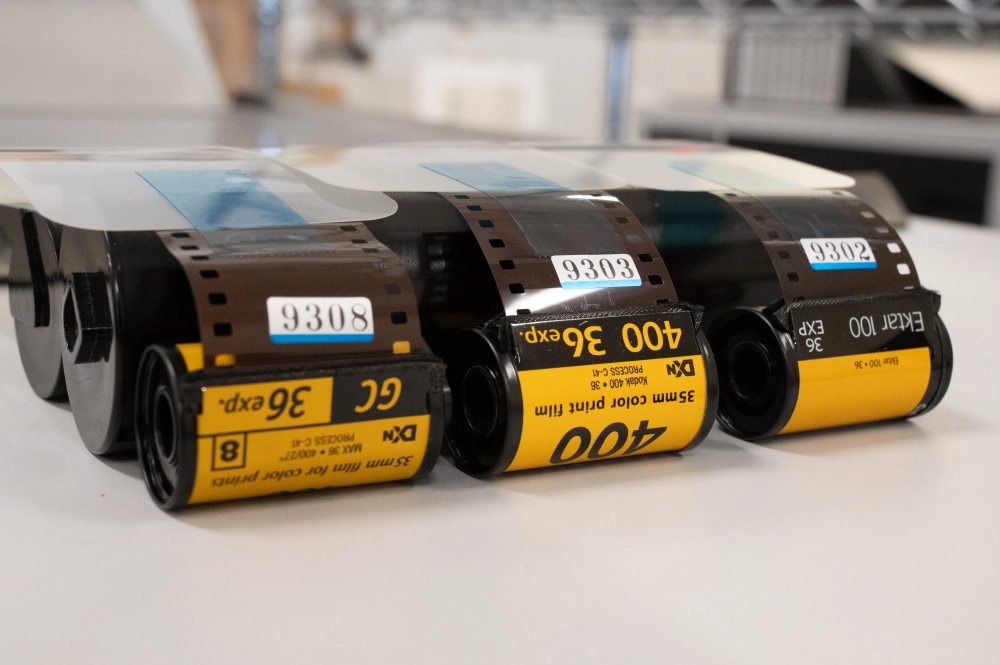
C-41 is the most common process and covers the majority of color negative film you'll find at a drugstore or camera shop. Think Kodak Gold, Fuji Superia, or Kodak UltraMax. If your film has an orange-tinted base when you hold it up to the light, it's almost certainly C-41.
Black-and-white film uses a separate, older chemistry that produces silver-based negatives. Crucially, not all black-and-white film is the same. Some modern B&W films, like Ilford XP2, are designed to be processed in C-41 chemistry, while traditional emulsions like Kodak Tri-X require dedicated black-and-white film developing.
E6 is for slide film (also called reversal or positive film), like Fujifilm Velvia or Kodak Ektachrome. Instead of a negative, you get a small transparent positive. The actual image on the film itself. E6 is rarer and more delicate, and very few labs still process it in-house.
ECN-2 is the process used for motion picture film stocks like Cinestill 800T. What makes it different is a remjet backing layer on the film that must be removed before processing. Skipping this step can destroy equipment. Most consumer labs won't touch it.
How to Mail Your Film to National Photo
Mailing irreplaceable film doesn't have to be nerve-wracking. Follow these steps and your rolls are in good hands.
Step 1
Don't rewind too fast. Static electricity from rapid rewinding can cause light streaks on your negatives before they ever leave your camera. Rewind slowly.
Step 2
Keep film in its canister. Never put loose rolls in a plastic bag. Canisters protect against light leaks and physical damage in transit.
Step 3
Use a padded mailer or small box. A bubble mailer works well for a few rolls; a small cardboard box is better for larger batches. Avoid rubber bands around canisters. They can dent the felt light traps.
Step 4
Include your contact info and order details. Write your name, email, phone number, and a note about what services you'd like (develop only, scans, push/pull processing, etc.). If you placed an order on the National Photo website first, include your order number.
Step 5
Ship with tracking. Film isn't replaceable. Please use USPS Priority Mail, UPS, or FedEx, or any other service in Washington, DC that provides a tracking number. Insurance is inexpensive and worth it.
Send everything to National Photo, and wait for the film processing results.
Ready to send in your first roll? Get started at National Photo!
Start Your Film OrderFrequently Asked Questions
-
What is your turnaround time for film developing?
Same-day color film developing is available Monday through Friday at National Photo for orders submitted before 1 PM. For customers who need faster turnaround, we also offer RUSH next-day film processing Monday through Thursday. Black-and-white film is processed approximately three times per week, depending on volume. E6/slide film and ECN-2/motion picture still film are processed in-house and typically take between 2–4 weeks depending on volume.
-
Can expired film still be processed?
Yes. Expired film can still produce images, though colors, grain, and contrast may shift with age and storage conditions.
-
What scan resolution should I choose?
Lower-resolution scans work well for social media and casual sharing, while higher-resolution scans are better for printing, archiving, and professional projects.
-
Should negatives be saved after scanning?
Absolutely. Negatives serve as your original image source and can be rescanned later for larger prints or future projects.
-
How should film negatives be stored long-term?
Store negatives in archival sleeves in cool, dry environments away from humidity, sunlight, and heat.